October 31, 2026


Spring in a city does not announce itself from a hilltop. It arrives in fragments: a sticky horse chestnut bud on a pavement tree, a buff-tailed bumblebee working a dandelion in a gutter crack, a blackbird singing at 5:40 in the morning when it was silent two weeks ago. If you walk the same route most days, you already have the best instrument for noticing this — repetition. The trick is knowing what to look at.
What follows is a watch list, not a calendar. Cities run a little warmer than the countryside around them, so street trees often leaf out days ahead of the same species in open fields, and a sheltered south-facing wall can serve up blossom while a north-facing one is still asleep. Use these ten signs as prompts, adjust for your latitude and your street, and keep a note of what you see.
Before anything flowers, the buds tell you what is coming. Learn three or four street trees on your regular route and check them once a week. You will see the change faster than you expect.
Horse chestnut is the easiest starting point. Its buds are large, dark and sticky, and the resin is thought to help protect the young tissue inside from cold and pests. In late winter the scales begin to part and the whole bud looks varnished and swollen, like something about to split. Lime and plane trees — the workhorses of many city streets — push their buds later and less dramatically, but the colour shift from brown-green to a brighter, fresher green is unmistakable once you know the tree.
Then there are catkins. Hazel gives you the classic lambs' tails, lengthening and yellowing as they release pollen. Birch catkins hang in small clusters that stretch out and loosen. These are wind-pollinated trees, so there is no need to charm a bee — they simply need to be ready when a dry breeze comes through.
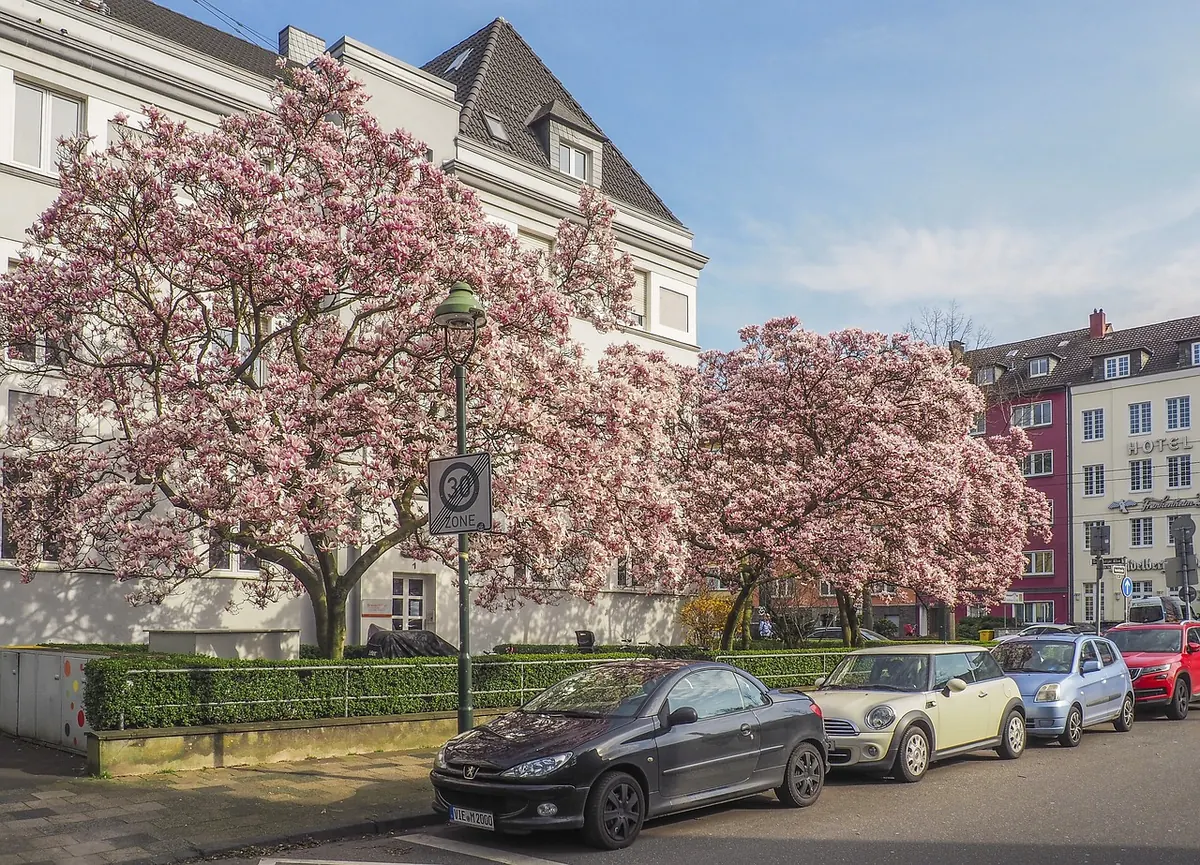
Flowering is the sign most people notice, partly because it makes a mess. Blackthorn is usually the first of the Prunus family to open in the UK and much of northern Europe, frothing white along hedgerows and boundary walls well before its leaves appear. Cherry plum can beat it by a week or two. Ornamental cherries follow on street plantings, and then the magnolias, which in some cities are as reliable a marker of early spring as anything in a park.
Here is a small identification shortcut worth carrying: if the white blossom appears on bare, spiny branches, it is likely blackthorn. If the tree has leaves already and the flowers come later, in looser clusters, you are probably looking at hawthorn. The two are constantly confused, and the difference tells you which half of spring you are standing in.
Do not pick. Street blossom is short-lived, heavily visited by insects, and often on trees that are already stressed by drought, dog urine and compacted roots. Photograph it, note the date, and let it fall. The drift of petals along the kerb — pink and white caught in drains and against parked cars — is itself a useful record of how far the season has moved.
Birdsong is the sign you can collect with your eyes closed. Robins sing through winter, so the robin alone is not your marker. What changes is density: more species joining in, earlier starts, and the overlapping territories that turn a single voice into a chorus.
Listen for the great tit's two-note seesaw, the blackbird's unhurried fluting from a rooftop aerial, and the song thrush repeating each phrase two or three times. Dawn is the best window, but city noise masks it — a quiet Sunday morning in March will often give you more than a weekday commute.
Once pairs are established, the work becomes visible. Watch for birds carrying nesting material: moss, dried grass, small twigs, feathers, and in cities a fair amount of paper and plastic. Feral pigeons are famously casual about construction, dropping a few crossed twigs on a ledge and calling it a nest. Gulls return to chimneys and flat roofs; if you have ever been shouted at from above in April, you know.
If you put up a nest box, face it somewhere sheltered from the worst of the weather and direct sun, mount it securely, and then leave it alone. Cleaning and inspection belong in autumn or winter, not during the breeding season.
The first bees of the year are usually queens — large, loud, flying low and zigzagging as they search for a place to start a colony. Buff-tailed bumblebee queens are common in gardens and on verges and often nest underground in old rodent burrows or under sheds. Watch one patrolling a sunny patch of bare soil or a stone wall and you are watching house-hunting, not foraging.
Hoverflies appear as stationary specks that hang in the air and then dart sideways. Brimstone butterflies, which overwinter as adults, can be out on the first genuinely mild day, and a sulphur-yellow shape moving along a hedge line is worth stopping for.
Early nectar is scarce, which is why the plants we dismiss as weeds matter so much. Dandelions, dead-nettles, groundsel, daisies in a lawn that has not been cut yet — these are the filling stations of March and early April. A patch of unmown grass and a few deliberate dandelions will support more insects than a tidy bed of bedding plants that flower in June.
The single most reliable signal is not visual at all: the evenings get longer, and quickly. A walk you took in near-darkness in January is suddenly bright, and everything else — flowering, birdsong, insect activity — follows the light.
Then look down. Ants resume their columns along pavement cracks and kerb edges. Moss on north-facing walls turns vivid after rain. Annual meadow grass and shepherd's purse green up in the joints of the paving. Soil in a raised bed stops feeling cold and wet and starts to feel merely damp, which is when seeds begin to germinate.
Weeds in pavement cracks are also a decent casual indicator of how much foot traffic a spot gets and how wet it stays — a small piece of urban ecology you can read in ten seconds on your way to the shop.
The value of this kind of watching comes from consistency, not expertise. You do not need to identify everything to the species level; "small bee, dark, on the rosemary by the bus stop" is a perfectly good record. Over a season you will build a personal timeline of your street, and next year you will be able to compare — which is when the observations get genuinely interesting.
Two practical notes. First, keep your distance from nests, dens and anything that looks like it is being guarded; disturbance does real harm. Second, if you garden in a window box, balcony or shared bed, the most useful spring action is restraint: leave the dandelions a little longer, hold off on the first big tidy-up, and let the earliest flowers finish before you cut them back. The season will show you the rest.
Photo: 652234 / Pixabay
Growing citrus and green life along the streets.
Copyright © 2026 Arancio Della Strada. All rights reserved. Arancio Della Strada.